Reverse Genetic Screen Reveals that Il34 Facilitates Yolk Sac Macrophage Distribution and Seeding of the Brain
L. E. Kuil, N. Oosterhof, S. N. Geurts, H. C. van der Linde, E. Meijering, T. J. van Ham
Disease Models & Mechanisms, vol. 12, no. 3, March 2019, p. 037762


Microglia are brain resident macrophages, which have specialized functions important in brain development and in disease. They colonize the brain in early embryonic stages, but few factors that drive the migration of yolk sac macrophages (YSMs) into the embryonic brain, or regulate their acquisition of specialized properties are currently known. Here, we present a CRISPR/Cas9-based in vivo reverse genetic screening pipeline to identify new microglia regulators using zebrafish. Zebrafish larvae are particularly suitable due to their external development, transparency and conserved microglia features. We targeted putative microglia regulators, by Cas9/gRNA-complex injections, followed by neutral red-based visualization of microglia. Microglia were quantified automatically in 3-day-old larvae using a software tool we called SpotNGlia. We identified that loss of the zebrafish colony stimulating factor 1 receptor (CSF1R) ligand IL34, caused reduced microglia numbers. Previous studies on the role of the IL34 on microglia development in vivo were ambiguous. Our data, and a concurrent paper, show that in zebrafish, il34 is required during the earliest seeding of the brain by microglia. Our data also indicate that Il34 is required for YSM distribution to other organs. Disruption of the other CSF1R ligand, Csf1, did not reduce microglia numbers in mutants, whereas overexpression increased the number of microglia. This shows Csf1 can influence microglia numbers, but might not be essential for the early seeding of the brain. In all, we identified il34 as a modifier of microglia colonization, by affecting distribution of YSMs to target organs, validating our reverse genetic screening pipeline in zebrafish.
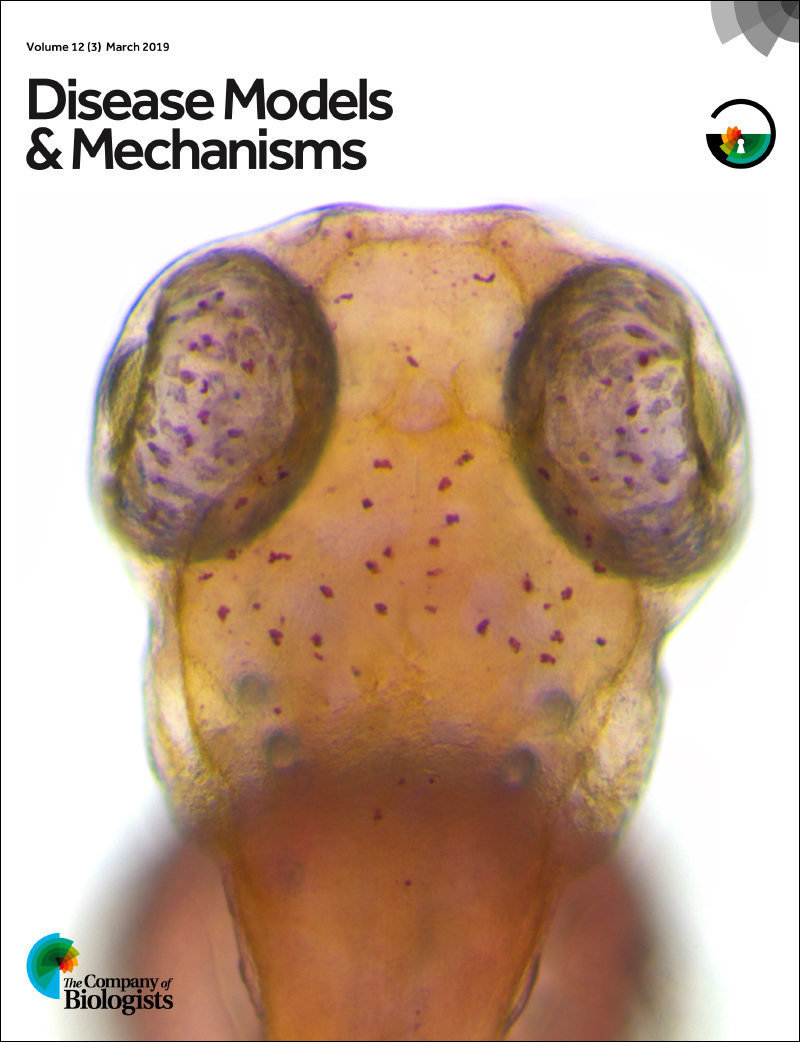
The cover of the journal issue shows a microscope image of a zebrafish with red-labeled microglia in the brain analyzed by the software tool SpotNGlia presented in the paper.
Copyright © 2019 the authors. Published version © 2019 The Company of Biologists. Personal use of this material is permitted. However, permission to reprint or republish this material for advertising or promotional purposes or for creating new collective works for resale or redistribution to servers or lists, or to reuse any copyrighted component of this work in other works, must be obtained from the copyright holder.
