SpotNGlia: Quantitative Analysis of Microglia in Bright-Field Images of Zebrafish
S. N. Geurts
Master Thesis, Delft University of Technology, November 2019
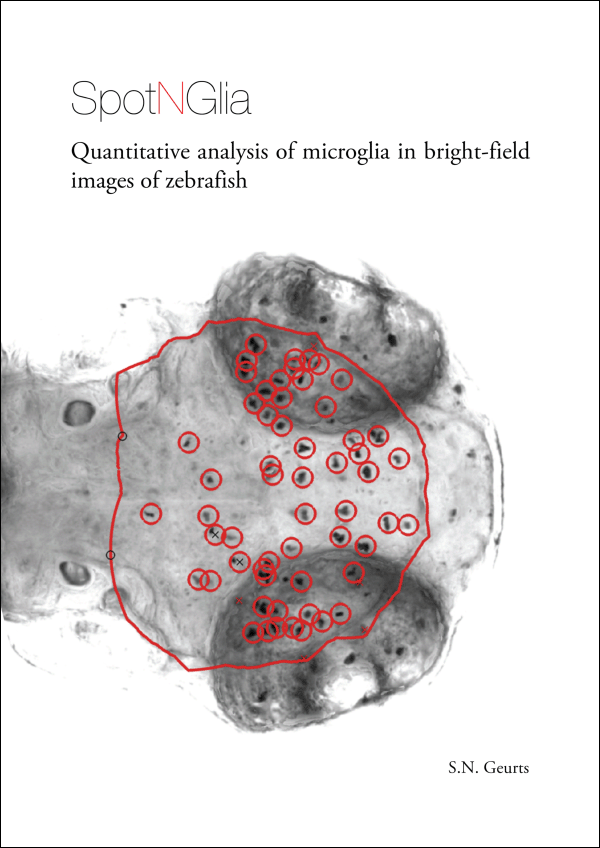
Microglia cells are known to have a multipurpose role in the development and maintenance of the brain. Recently a reverse genetic screening pipeline was developed to identify new microglia regulating genes in zebrafish. It is an effective way to discover new regulators, but it is time consuming as it involves manual preparation, imaging, and analysis. This thesis presents a semiautomatic tool, SpotNGlia, that replaces the most tedious part of the pipeline: the quantification of microglia. SpotNGlia is able to quantify neutral red stained microglia in z-stack images of zebrafish larvae that are imaged with bright-field microscopy three days past fertilization. The method starts with image corrections based on correlation. Thereafter, image merging is applied with variance filtering to convert the z-stack to a single image per fish preserving the microglia. Registration is done using intrinsic rotation based on the symmetry property of the fish. The brain is segmented using polar transformation and dynamic computing to set a boundary for the microglia. The wavelet multiproduct is used to detect spots. Finally, a threshold on the found spots based on size and color determines which of them are microglia. The algorithm is tested with a representative data set consisting of 50 fish with manually annotated microglia. The accuracy of the algorithm in terms of detection precision, recall, and F1 scores, is 0.79, 0.90, and 0.84, respectively. These outcomes demonstrate that SpotNGlia is able to identify microglia in most of the cases. However, in case of incorrect quantification, SpotNGlia offers the possibility to apply manual corrections afterwards within a convenient user interface. With this functionality, it is found that SpotNGlia reduces the time normally spent on the counting process by 80%. Yet, many adjustments to the algorithm are suggested for further research to improve accuracy, efficiency, and usability.
Copyright © 2019 the author. Published version © 2019 Delft University of Technology. Personal use of this material is permitted. However, permission to reprint or republish this material for advertising or promotional purposes or for creating new collective works for resale or redistribution to servers or lists, or to reuse any copyrighted component of this work in other works, must be obtained from the copyright holder.
